New Essay — Youth, Megacities, and Culture in the Age of Consequences (Expanded Liverpool Thesis)
I just completed this draft essay / book chapter (below), which explores our obligations as global citizens and museum practitioners at a moment of extraordinary change—an Age of Consequences and cultural revolution.
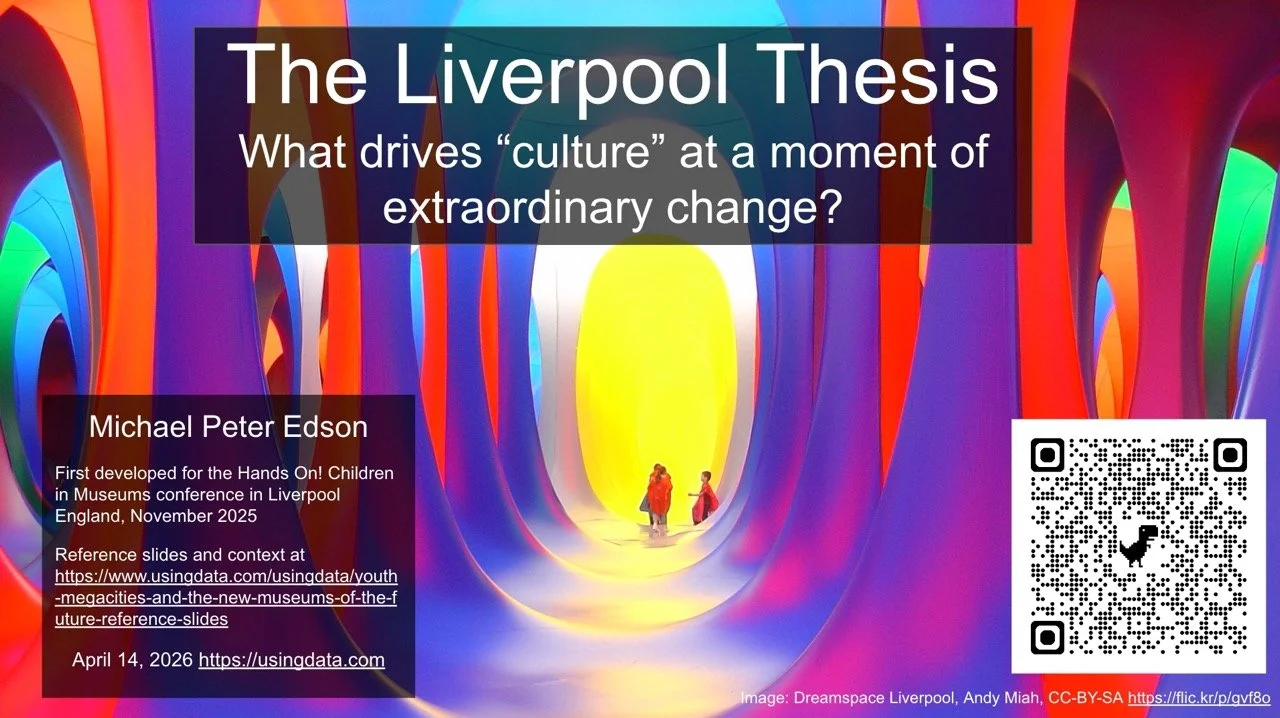
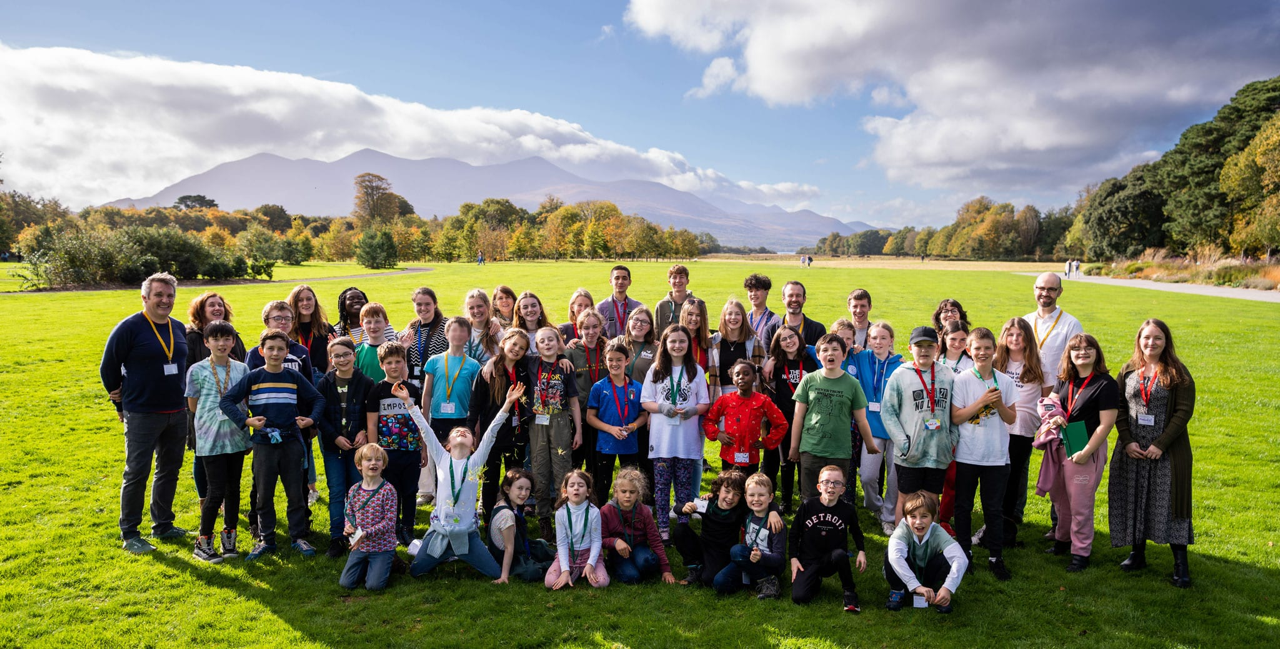
I’ve been wrestling these ideas to the ground for almost a year now, since preparing for a talk I gave at the 2025 Children in Museums conference in Liverpool (hence the “Liverpool Thesis”), and this my most thorough and detailed effort so far, with a long bibliography and a long-long list of citations.
Note that this is my unedited, Author’s Original Manuscript (AOM) for a chapter in a book to be published in 2027 by IKTF, the Institute for Cultural Participation Research / Instituts für kulturelle Teilhabeforschung and Transcript Verlag, Germany. The book is an anthology from the 2025 “Children in Museums” Connected Audience conference in Liverpool, England, with a working title of Culture & Young People – What Could Possibly Go Wrong? The anthology will be edited by Vera Allmanritter and Julia Glesner.
This essay is CC-BY-NC-SA Michael Peter Edson, August 23, 2026.
Here’s the Intro below, or you can jump to the full essay on a new page…
Introduction
At the 2023 opening gala for the Museum of Solutions in Mumbai (MuSo) I approached a middle-aged guest and asked how he was enjoying the evening.
“I am angry,” he told me. “This museum is a jewel, but where were you 30 years ago when I was a child? And where are you now in the thousands of other places where a museum like this is needed?”
I was surprised and inspired by his response. Surprised, because few people expect a children’s museum to have such significance; and inspired because I felt he had perfectly sensed our purpose and ambitions and he felt they were too small. And I agree with his assessment: indeed, where are we — our sector, broadly writ, of children’s museums and all museums at a moment of extraordinary human and planetary change? Why build a children’s museum in Mumbai at all, or any museum in a world beset by social, technological, and environmental challenges?
Museums evolve in response changes in society. In the 1820s, visitors to the British Museum underwent rigorous personal vetting by the Director before earning a quick, supervised visit to the collection. Two centuries later, the British Museum has a different entry scheme and a different role in the world. But if the purpose and methods of the museum have always been fluid, the question now is whether we can get museum practice and practitioners to change quickly enough to meet a moment of breathtaking biological and socio-technical rupture.
This essay lays out a five-point thesis regarding our current moment in human culture and planetary systems, exploring our obligations as global citizens and museum practitioners, particularly within the discipline of children’s museums:
We are in the middle of anew kind of cultural revolution — an “Age of Consequences” where the compounding effects of choices made across social, technological, and natural systems are becoming the predominant driver of human events.
This revolution and rupture is unfolding everywhere, but it is most acutely seen and addressed in megacities and on the “Global Street.”
Third, within this landscape, young people must be recognized and supported as consequential civic actors with unique rights, stature, and capabilities. This conceptualization of youth is growing globally, and is linked to the “rights of nature” and the “rights of future generations.”
Legacy cultural institutions are structurally “deranged”— hamstrung by twentieth-century habits that leave them ill-equipped to act as authentic allies to youth or relate to the hyper-velocity of rupture beyond their doors.
Museums, libraries, and knowledge/memory institutions must transform themselves into “places of appearance” that constitute the human process of natality (societal rebirth), acting as sites of imagination and renewal where new generations can manifest their agency through speech, presence, and action.
The acceleration of change and the perceived closing off of promising futures have cast new light on rights and capabilities of young people. While the Museum of Solutions (MuSo) in Mumbai was my first direct leadership role in a children’s museum, the experience solidified my belief that this sub-discipline deserves greater visibility and higher stakes. I believe museums, libraries, and other cultural, scientific, and performing arts organizations must now view themselves as essential components of a global response to the Age of Consequences and the project of building a more just, sustainable, and joyous world, with particular attention to the rights and capabilities of young people.
I write this essay not as an academic but as a cultural practitioner, maker, and doer. This perspective is informed by a career dedicated to increasing the openness and democratic vibrancy of cultural institutions and advancing the right to culture, as framed by the Universal Declaration of Human Rights, which includes the right to access and contribute to the cultural and scientific life of the community (United Nations General Assembly 1948). This right is more than symbolic: it is at the heart of our capacity to understand the world we are living in and to make good decisions regarding its future.
Note: this related article, Libraries, AI, and the Age of Consequences, follows a similar thesis but goes into greater depth regarding epistemic attacks on the cultural sector and the posture of libraries and other cultural/knowledge institutions regarding AI.